Book
Justice Barrett's memoir on the Supreme Court and constitutional interpretation.
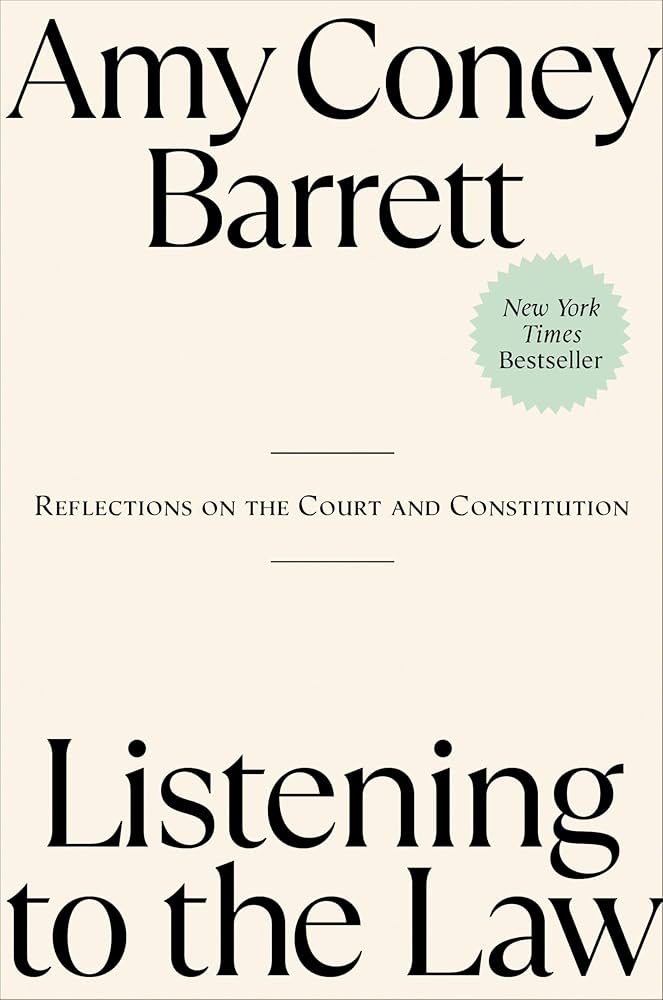
Listening to the Law: Reflections on the Court and Constitution
Justice Barrett's memoir offers insight into her path to the Supreme Court and her judicial philosophy. The work addresses questions Americans have posed since her confirmation hearing, covering topics like her adjustment to the Court, her daily life managing both judicial responsibilities and raising school-age children, and the relationships among justices.
Barrett explains her approach to constitutional interpretation, shares anecdotes from her clerkships with Justice Scalia and Judge Silberman, and walks readers through prominent cases. The book combines personal narrative with explanation of how the Court functions, written with the clarity and warmth for which she was known as a law professor.
Interviews
-
Advisory Opinions with Sarah Isgur and David French
Justice Barrett sits down with hosts Sarah Isgur and David French in the Lawyer's Room at the Supreme Court to discuss her new book, Listening to the Law. The conversation covers originalism, her experience clerking for Justice Scalia, the equity docket, the role of oral arguments, and considerations for law school education.
-
Interesting Times with Ross Douthat
Justice Barrett discusses the current Court's most controversial rulings and explains why she believes her originalist interpretations resist ideological pressures. She also expresses discomfort with being viewed as a cultural icon. Topics include the rationale behind overturning Roe v. Wade, the role of stare decisis, judicial fallibility, and the Court's relationship with the executive branch.
Reviews
-
‘Listening to the Law’ Review: A Humbler Reading
“I can’t say that I always like the rhetoric in others’ opinions—or that I never write too harshly myself,” observes Supreme Court Justice Amy Coney Barrett in “Listening to the Law.” By “others” I would hazard she refers to Justices Sonia Sotomayor and Ketanji Brown Jackson, both of whom tend to catastrophize in dissent. A recent case on nationwide injunctions included a few fiery salvos between Justice Barrett and her two most liberal colleagues. Nonetheless, she goes on, “even the sharpest exchanges on the Court are driven by disagreement about the law rather than personal animosity.”
Justice Barrett’s book, accordingly, is a model of collegiality. My own conclusions from it are, first, that she has a sharp and well-organized mind, and, second, that she is a very nice person.
-
What does Amy Coney Barrett really think? Her new book offers some clues.
Amy Coney Barrett is the most important justice on the Supreme Court today. It’s not because of her legal acumen, although she is undoubtedly one of the most brilliant lawyers on the court. Nor is it because of her seniority: She’s the second-most-junior justice. It’s because, at this crucial moment in the history of the rule of law in the United States, she has turned out to be the decisive vote. With four justices to her right and four to her left in crucial case after crucial case, Barrett has the power to determine outcomes in decisions involving the Trump administration’s unprecedented attacks on the constitutional system as we know it.
How a deeply conservative law professor turned Trump appointee who cast the deciding vote to overturn Roe v. Wade has found herself in this strange position is the unstated subject of Barrett’s new book, “Listening to the Law.” Although framed as an accessible introduction to constitutional basics and how the Supreme Court works, the book is actually much more. In unadorned, readable language, Barrett lays out the judicial philosophy she uses to decide cases. That philosophy, it turns out, explains why Barrett has found herself at the center of the court.
-
Amy Coney Barrett’s Memoir Is as Careful and Disciplined as Its Author
Justice Amy Coney Barrett has had quite the journey. Since joining the Supreme Court in 2020, she has voted with the conservative majority to clip the powers of federal agencies, end affirmative action, expand gun rights and overturn Roe v. Wade. Yet the handful of times that Barrett has sided with the three liberal justices she has elicited paroxysms of MAGA rage, with conservative pundits denouncing her as “evil,” a “closet liberal,” a “D.E.I. hire.”
Some of that right-wing fury has died down in the last couple of months, seemingly quelled by Barrett’s majority opinion at the end of June, which handed a victory to President Trump by limiting the ability of federal courts to issue nationwide injunctions.