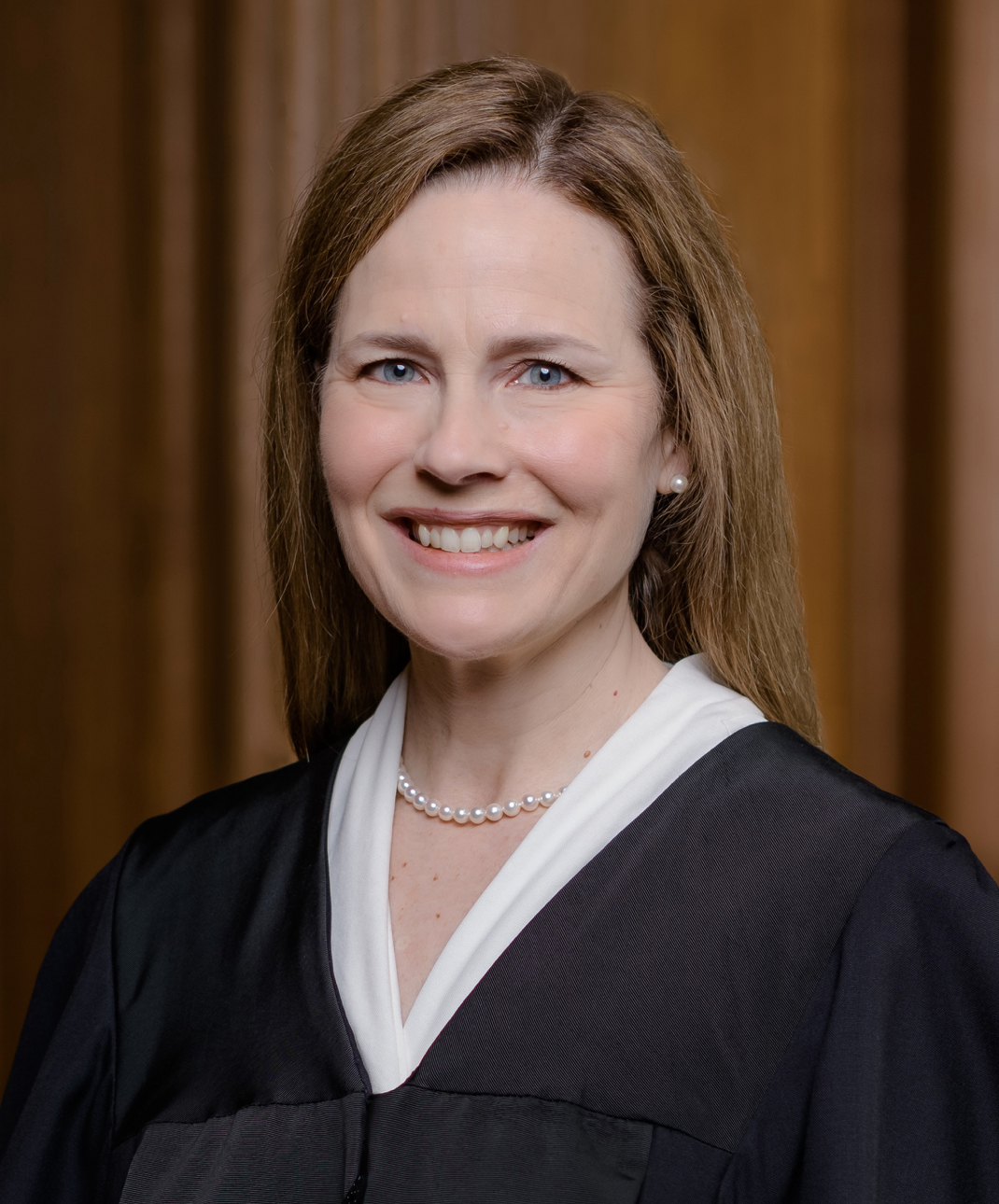
Amy Coney Barrett is an Associate Justice of the Supreme Court of the United States. She was nominated by President Donald J. Trump and has served on the Court since her confirmation in October 2020.
Born in New Orleans, Louisiana, in 1972, Barrett graduated from Rhodes College and earned her law degree from Notre Dame Law School, where she graduated first in her class. She clerked for Judge Laurence Silberman on the U.S. Court of Appeals for the D.C. Circuit and for Justice Antonin Scalia. Before joining the Court, she was a professor at Notre Dame Law School and served as a judge on the U.S. Court of Appeals for the Seventh Circuit from 2017 to 2020.
“No one disputes that the Executive has a duty to follow the law. But the Judiciary does not have unbridled authority to enforce this obligation—in fact, sometimes the law prohibits the Judiciary from doing so. See, e. g., Marbury v. Madison, 1 Cranch 137 (1803) (concluding that James Madison had violated the law but holding that the Court lacked jurisdiction to issue a writ of mandamus ordering him to follow it). . . . Observing the limits on judicial authority—including, as relevant here, the boundaries of the Judiciary Act of 1789—is required by a judge's oath to follow the law.”
— Trump v. CASA, Inc. (2025)
Notable Opinions
Trump v. CASA, Inc.
OT 2024 Majority OpinionHeld that nationwide injunctions exceed the power that Congress has given to the judiciary, concluding that injunctions must be no broader than necessary to provide complete relief to each plaintiff with standing to sue.
Biden v. Nebraska
OT 2022 ConcurrenceOffered her justification and interpretation of the major questions doctrine, arguing that it is not a new or atextual substantive canon but rather “a tool for discerning—not departing from—the text's most natural interpretation.”
United States v. Skrmetti
OT 2024 ConcurrenceExplained why the Court's Equal Protection Clause precedents do not demand heightened judicial scrutiny of laws that classify based on transgender status. Rather, rational-basis review applies, “which means that courts must give legislatures flexibility to make policy in this area.”
United States v. Rahimi
OT 2023 ConcurrenceSupported the majority's application of Bruen and wrote separately to explain the premises of originalism and to clarify how courts should apply the history-and-tradition framework. In her view, Bruen does not require a challenged regulation to be an updated model of a historical counterpart.
Opinions by Supreme Court Term
- October Term 2025
- October Term 2024
- October Term 2023
- October Term 2022
- October Term 2021
- October Term 2020
Prior Judicial Service
Scholarship
Recent Opinions
Watson v. Republican National Committee
Majority Election LawWriting for the Court, Justice Barrett held that federal Election-Day statutes do not prevent Mississippi from counting absentee ballots postmarked by Election Day but received up to five days thereafter, because nothing in the federal Election-Day statutes requires ballots to be received by Election Day.
Chatrie v. United States
Dissent Fourth AmendmentJustice Barrett wrote that while she has no quarrel with Carpenter v. United States, she agrees with Justice Alito that under the Court's Fourth Amendment precedents, Chatrie had no reasonable expectation of privacy in data about his public movements that he voluntarily disclosed to Google.